Type 1 vs. Type 2 NPI: Which One Goes on the Claim?
A single wrong identifier in the wrong box is enough to send an otherwise clean claim back as a denial — and National Provider Identifier (NPI) mix-ups are one of the most common, most avoidable causes. If you run a solo practice, work for a group, or recently incorporated, the
type 1 vs type 2 NPI distinction decides which 10-digit number goes where on every claim you submit. Get it right and claims flow; get it wrong and you chase “provider not eligible” denials for work you already did. This guide explains both NPI types in plain English, shows exactly where each one belongs on the CMS-1500 claim form, and walks through the incorporated solo-provider trap that catches so many practices. Getting these details right is a core part of professional
medical coding and credentialing services — and the fixes here are ones you can apply to your next batch of claims.

What Is a Type 1 NPI?
A Type 1 NPI identifies an
individual healthcare provider — a physician, nurse practitioner, physician assistant, physical therapist, psychologist, or any other individual who delivers care. It is issued to a person, not to a business, and it follows that person for their entire career, no matter how many practices they join or leave.
Key facts about Type 1 NPIs:
- Who holds one: individual providers, including sole proprietors. A sole proprietor who has never incorporated has only a Type 1 NPI.
- How it is issued: the individual applies through the National Plan and Provider Enumeration System (NPPES), using their Social Security Number for identification.
- How many: one per person. An individual provider has exactly one Type 1 NPI, and it never changes — even if they change names, states, employers, or specialties (the NPPES record is updated, but the number stays the same).
- What it is used for: identifying the individual who rendered the service, and, for unincorporated solo providers, identifying the billing provider as well.
Think of the Type 1 NPI as the provider’s personal professional fingerprint: it answers the question “who actually treated the patient?”
What Is a Type 2 NPI?
A Type 2 NPI identifies an
organization — a group practice, clinic, hospital, agency, or an incorporated solo practice operating as a legal entity. It belongs to the business, not to any one clinician, and it stays with the organization even as individual providers join or leave.
Key facts about Type 2 NPIs:
- Who holds one: organizations, including a solo provider’s corporation, professional association, or LLC (when that entity is the billing entity). A group practice has a Type 2 NPI; so does an incorporated solo practice.
- How it is issued: an authorized official of the organization applies through NPPES, using the organization’s Employer Identification Number (EIN).
- How many: an organization has one Type 2 NPI, though large organizations may obtain additional Type 2 NPIs for distinct subparts (such as a separately located department) that bill independently.
- What it is used for: identifying the organization that bills for the service and receives payment.
Think of the Type 2 NPI as the business’s billing identity: it answers the question “which organization is billing for this care, and who should be paid?”
Type 1 vs Type 2 NPI: Side-by-Side Comparison
The two types look identical — both are 10-digit numbers with no embedded meaning — which is exactly why they get confused. The difference is entirely about
who the number belongs to.
|
Type 1 NPI |
Type 2 NPI |
| Belongs to |
An individual provider |
An organization |
| Examples |
Physician, therapist, nurse practitioner |
Group practice, clinic, incorporated solo practice |
| Issued via NPPES using |
Social Security Number |
Employer Identification Number (EIN) |
| How many |
One per person, for life |
One per organization (plus subparts if applicable) |
| Goes in Box 24J (rendering provider) |
Yes — almost always |
No, except rare organization-rendered services |
| Goes in Box 33a (billing provider) |
Yes, for unincorporated solo providers |
Yes, for groups and incorporated practices |
| Credentialed with payers |
Individual enrollment and CAQH profile |
Group contract and organizational enrollment |
| Follows the provider if they leave |
Yes |
No — stays with the organization |
Which NPI Goes Where on the Claim?
On the paper CMS-1500 form — and in the same logic on the electronic 837P claim — two boxes do most of the NPI work. Put the right number in each, and the payer can match the claim to both the clinician and the contract.
Box 24J: Rendering provider — almost always the Type 1 NPI
Box 24J holds the NPI of the
rendering provider: the individual who actually performed the service. For a therapist employed by a group, that is the therapist’s own Type 1 NPI. For a solo physician, it is their Type 1 NPI. The qualifier in Box 24I is “NPI” for this field. On an electronic claim, the rendering provider NPI travels in Loop 2310B.
Box 33a: Billing provider — Type 2 for groups, Type 1 for unincorporated solo providers
Box 33a holds the NPI of the
billing provider: the entity submitting the claim and expecting payment. For a group practice, that is the group’s Type 2 NPI. For an incorporated solo practice, it is the corporation’s Type 2 NPI. For a solo provider who has
not incorporated, the billing provider is the individual, so the Type 1 NPI goes in both Box 24J and Box 33a. On an electronic claim, the billing provider NPI travels in Loop 2010AA.
Three scenarios, answered
| Your situation |
Box 24J (rendering) |
Box 33a (billing) |
| Unincorporated solo provider |
Your Type 1 NPI |
Your Type 1 NPI |
| Incorporated solo provider (PC, PA, PLLC, or LLC as the billing entity) |
Your Type 1 NPI |
Your organization’s Type 2 NPI |
| Clinician employed by or contracted with a group |
Your Type 1 NPI |
The group’s Type 2 NPI |
One related field trips people up too: Box 25, the federal tax ID. For a group or incorporated practice, Box 25 carries the organization’s EIN (with the “EIN” box checked); for an unincorporated solo provider, it carries the individual’s SSN or EIN (with the matching box checked). The tax ID and the billing NPI must describe the same entity, or the claim invites a mismatch denial.
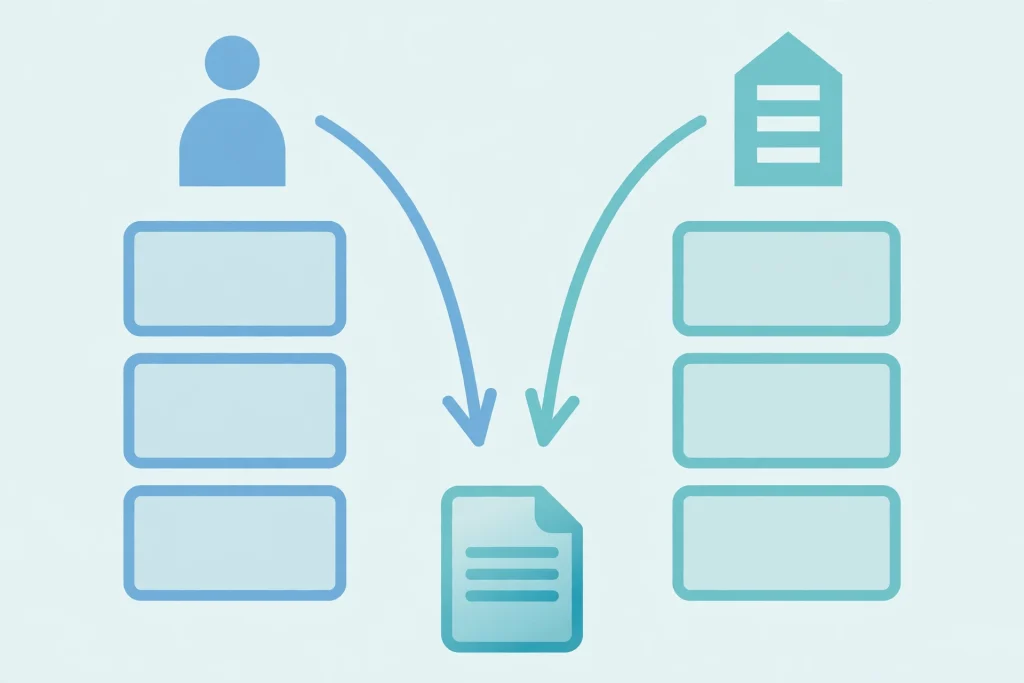
The Incorporated Solo-Provider Trap
The single most common Type 1 vs Type 2 NPI mistake happens when a solo provider incorporates — and then keeps billing exactly as before. Incorporation creates a new legal entity, and that entity needs its own Type 2 NPI, its own payer enrollment, and its own place on the claim. Skipping any step breaks the chain.
Here is how the trap usually unfolds:
- You incorporate, but never apply for a Type 2 NPI. Your corporation has no NPI of its own, so claims keep going out under your Type 1 NPI as the billing provider — even though the payer’s contract, if one exists, is now with the corporation.
- You get a Type 2 NPI, but never enroll it with payers. The payer’s system knows your Type 1 NPI but has never seen the Type 2 NPI, so claims billed under the organization deny as “provider not eligible” or “billing provider not on file.”
- You enroll the Type 2 NPI, but forget the linkage. Payers need to know that your Type 1 NPI renders services under that Type 2 NPI. If the rendering provider is not linked to the billing organization in the payer’s system, claims deny even though both NPIs are individually valid. This is the same linkage problem that makes a group’s in-network status fail to protect an individual therapist’s claims — if the therapist’s NPI is not linked to the group, the claims deny anyway.
- You bill the Type 2 NPI in Box 24J. The rendering provider is a person, not a corporation. Putting the organization’s NPI where the rendering clinician’s NPI belongs tells the payer the wrong provider performed the service, and the claim denies or misprocesses.
The fix is a sequence, not a single correction: obtain the Type 2 NPI from NPPES, enroll the organization with each payer, link your Type 1 NPI as a rendering provider under that organization, confirm the linkage is active before you submit claims under the new arrangement, and only then switch Box 33a to the Type 2 NPI. Our earlier guide to the group-therapist version of this problem —
when a group is in-network but the therapist’s claims keep denying, check NPI linkage — walks through the same linkage check step by step.
Group vs Individual: What Changes for Credentialing?
NPI type also determines how credentialing works, because payers enroll individuals and organizations through different tracks:
- Individual (Type 1) credentialing runs through the provider’s own CAQH profile, license, education, and malpractice history. This is the track that decides whether you may render services under a payer’s plan.
- Group (Type 2) credentialing runs through the organization’s contract, practice locations, tax ID, and roster of rendering providers. This is the track that decides whether the practice may bill the payer and be paid.
- Both tracks must be complete. An enrolled group with an unenrolled rendering provider denies, and an enrolled provider billing under an unenrolled group denies. One without the other is not enough.
- Timelines differ. Individual credentialing commonly takes 60–120 days per payer, while adding a provider to an already-contracted group (via roster or linkage update) is often faster — but neither happens instantly, so start both tracks before the provider’s first date of service. Our CAQH credentialing guide covers the individual track in detail.
What Happens When You Use the Wrong NPI?
Wrong-NPI claims rarely fail quietly. The usual outcomes are:
- Denials stating the provider is not eligible, not enrolled, or not on file for the date of service — the payer cannot match the billed NPI to an enrolled provider or organization.
- Payment to the wrong entity — if the billing NPI resolves to a different organization than intended, payment follows the NPI, not your intent.
- Clean-claim delays while the mismatch is investigated — and if the delay pushes the claim past the payer’s timely filing limit, a fixable error can become an uncollectible one.
- Repeated denials on every claim in a batch — because the error sits in your practice-management system’s provider setup, not in a single claim, it repeats until the setup is corrected.
When you spot a pattern of NPI denials, fix the setup first and the claims second: correct the rendering and billing provider records in your practice-management system, verify the linkage with the payer, and then rebill or appeal the affected claims within the payer’s correction window.
FAQs
Can one person have both a Type 1 and a Type 2 NPI?
Yes — but they belong to different things. The person holds their Type 1 NPI, and their corporation or LLC holds a separate Type 2 NPI. The individual never “becomes” a Type 2; the organization is a distinct legal entity with its own number.
Do I need a Type 2 NPI if I am a solo provider?
Only if you practice through a separate legal entity, such as a corporation or PLLC that bills payers. An unincorporated sole proprietor needs only a Type 1 NPI, which goes in both Box 24J and Box 33a.
Does my NPI ever change?
No. A Type 1 NPI stays with the individual for life, and a Type 2 NPI stays with the organization. If you change your name, move states, or switch employers, you update your NPPES record — you do not get a new number. If an organization dissolves, its Type 2 NPI is deactivated, not transferred.
What is the difference between an NPI and a tax ID?
An NPI identifies
who provided or billed for the care; a tax ID (SSN or EIN) identifies
who gets paid for tax purposes. Both appear on the claim (NPI in Boxes 24J/33a, tax ID in Box 25), and they must describe the same billing entity.
How do I check whether my Type 1 NPI is linked to my group’s Type 2 NPI?
Call the payer’s provider services line or check its provider portal and ask whether your rendering NPI is affiliated with the group’s billing NPI and effective for the dates of service in question. If the payer shows no affiliation, submit a roster or linkage update and confirm it is active before resubmitting claims.
Next Steps
The Type 1 vs Type 2 NPI rule is simple once it is stated plainly: the Type 1 NPI is the person who rendered the care, and the Type 2 NPI is the organization that bills for it. Solo and unincorporated? Your Type 1 NPI does both jobs. Incorporated or in a group? Your Type 1 NPI renders, the organization’s Type 2 NPI bills — and both must be enrolled and linked with each payer before claims go out. Audit your practice-management system’s provider setup against the three-scenario table above, and fix any mismatch before your next claim batch. If credentialing, enrollment, or a pile of NPI denials is eating your team’s time, UMB and Coding can take it on —
contact us or call (201) 942-0949 for help.


Leave a comment