- info@umbandcoding.com
- 201-942-0949
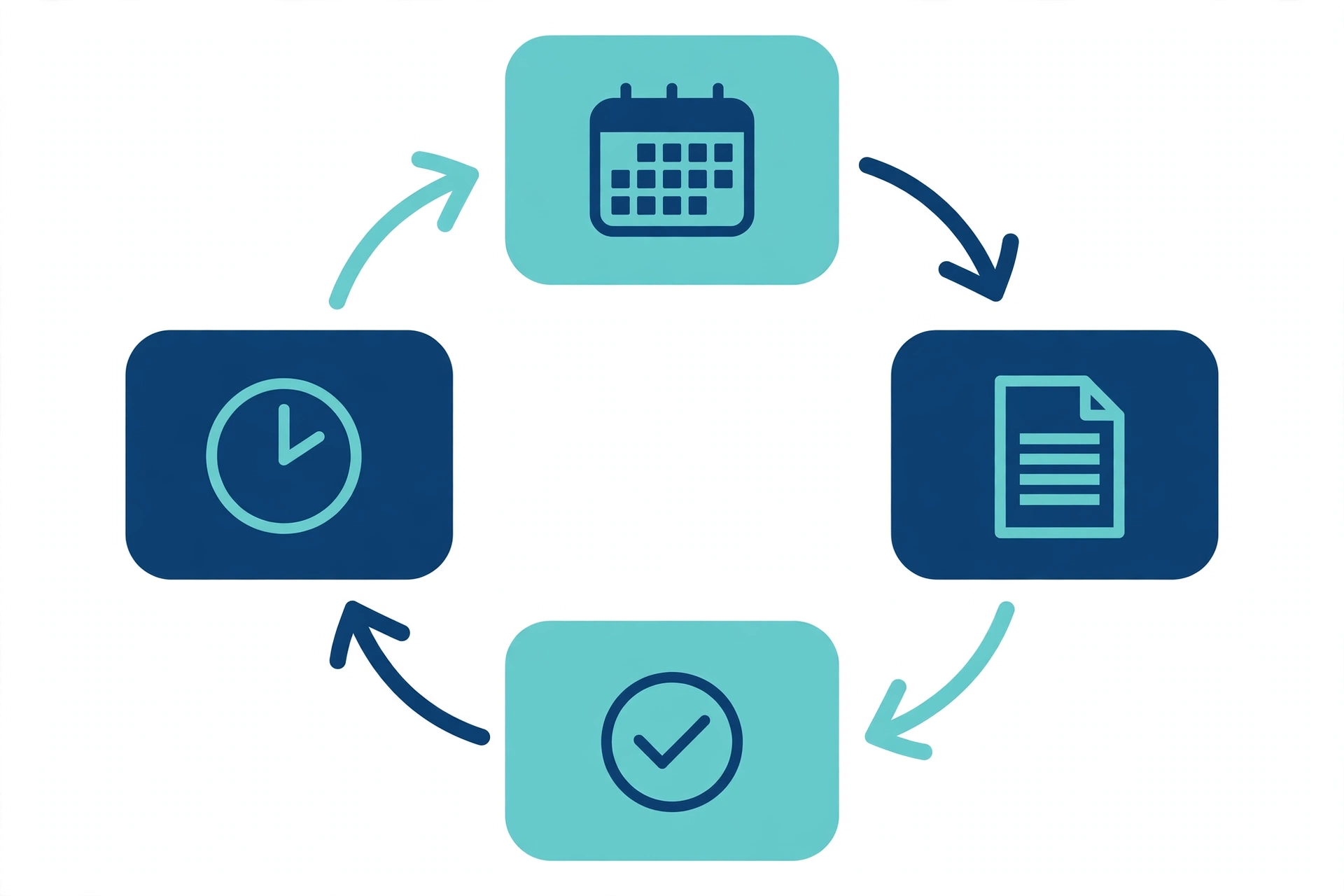
Getting credentialed is not a one-time event. Once a provider is in-network, the work shifts to staying in-network — and that means keeping two separate clocks running: the CAQH attestation clock, which expires every 120 days, and each payer’s recredentialing cycle, which typically comes around every two to three years. Miss either one, and claims can be held or denied; in the worst case a payer can suspend or end a provider’s participation. That is why credentialing services for providers treat re-attestation and recredentialing as scheduled maintenance, not paperwork to get to when there is time.
This guide explains the 120-day CAQH attestation rule, how payer recredentialing cycles differ from it, what a lapse can do to your claims and panel status, the recovery steps if a profile has already lapsed, and a simple calendar system that keeps both clocks from running out.
CAQH ProView is the shared credentialing database most commercial payers pull from. When a provider attests in CAQH, they are confirming that every section of their profile — license, education, work history, malpractice coverage, sanctions and disclosures — is current and accurate. That attestation expires after 120 days, after which the profile is flagged as needing re-attestation, and payers checking it will see that the information has not been recently confirmed.
Re-attestation is not a new application. It is a review-and-confirm step: log in to CAQH ProView, check each section for changes, update anything that has moved — a renewed license, a new malpractice policy, a changed practice address — and attest again. If nothing has changed, the review itself is quick. The risk is not the work; it is forgetting. A profile that sits unattested for months can hold up a new panel application, delay a roster update, or stall a recredentialing packet, because the payer’s first check is whether the CAQH data is current. Our step-by-step guide to the CAQH credentialing process covers the profile mechanics in detail, including the four profile mistakes that stall enrollment — the same mistakes behind most re-attestation failures.
Three details catch practices out. First, attestation is per provider, not per practice: a group with ten clinicians has ten separate 120-day clocks. Second, authorizing the profile for release to a payer is separate from attesting — an attested profile a payer is not authorized to view does the practice no good. Third, an expired document inside the profile, such as a lapsed malpractice face sheet, can block a clean attestation. Check document expiry dates at every re-attestation, not just when a payer asks.

Payer recredentialing is the payer’s own periodic re-check of a provider who is already in-network. Where CAQH attestation is a single shared profile refreshed every 120 days, recredentialing is each payer verifying, on its own schedule, that the provider still meets its participation standards: license in good standing, current malpractice coverage, no new sanctions, and an up-to-date practice profile.
The cycles differ by payer. Many recredential every three years, following the National Committee for Quality Assurance (NCQA) standard; some use a two-year cycle; a few run on their own timetable entirely. The process differs too: some payers pull the provider’s CAQH profile and ask only for confirmation, while others send their own recredentialing application or require submission through a payer portal. Reminders differ as well — one payer may warn you 90 days out, another 30, and another may send none at all and expect the practice to know its own date.
| CAQH re-attestation | Payer recredentialing | |
|---|---|---|
| How often | Every 120 days | Typically every 2–3 years, varies by payer |
| Who initiates it | The provider (or their credentialing team) | The payer, on its own schedule |
| Where it happens | CAQH ProView, one shared profile | Per payer — CAQH pull, payer portal, or paper packet |
| What it checks | Profile accuracy across all sections | Continued eligibility: license, malpractice, sanctions, practice status |
| If it is missed | Profile flagged as not current; applications and updates can stall | Panel status at risk; re-enrollment may be required |
The practical point is that the two clocks are independent. A freshly attested CAQH profile does not satisfy a payer whose recredentialing deadline has passed, and completing one payer’s recredentialing does nothing for the next payer’s deadline. Practices need both dates tracked — for every provider, for every payer.
A lapse is best understood as risk, not a guaranteed outcome: payers handle missed deadlines differently, and some offer a grace period or a warning before taking action. But the range of possible consequences is serious enough that no practice should rely on leniency.
With a lapsed CAQH attestation, the most common effect is a stall rather than a punishment. A payer reviewing a new application, a roster update, or a recredentialing packet may hold the file until the profile is re-attested, which delays the effective date and the revenue that depends on it. A therapist joining a group practice, for example, cannot be added to the roster while the underlying CAQH profile is out of date — and claims for that clinician’s sessions cannot be paid until the roster is active.
With a missed payer recredentialing deadline, the stakes are higher. A payer may suspend the provider’s participation, so claims for dates of service after the suspension can be denied or held. In some cases the payer may terminate the provider from the panel entirely, and reinstatement then means starting over with a new enrollment application rather than a simple renewal — a process that can take months. A terminated provider may also need to notify patients, since they can no longer be seen as in-network with that plan. Our guide on how long provider credentialing takes explains why a fresh enrollment takes so much longer than a renewal.
The revenue effect is the part practices feel first. Claims billed under a suspended or terminated provider do not simply wait: they deny, and the practice must choose between holding them in the hope of reinstatement, writing them off, or billing the patient — which is generally not appropriate for an in-network service. None of these outcomes is certain for any single missed deadline, but all of them are within the range of what payers can do.
If you discover a lapsed attestation or a missed recredentialing deadline, work the recovery in order — do not simply resubmit and hope. The sequence below is the same one a credentialing team follows, and it produces the paper trail you will need if claims are affected.
Preventing lapses is a tracking problem, not a knowledge problem. Most practices know the 120-day rule; they lose track of whose clock is running and when each payer’s cycle comes due. The system below needs one named owner, one shared tracker, and a weekly check — nothing more elaborate than that.
| What to track | Check when | Owner |
|---|---|---|
| CAQH attestation date, per provider | Monthly; re-attest at 90 days, never wait for day 120 | Credentialing owner |
| License and malpractice expiry dates | Monthly; flag anything expiring within 60 days | Credentialing owner |
| Payer recredentialing due dates, per provider per payer | Quarterly review; start the packet 90 days before the due date | Credentialing owner |
| CAQH release authorizations, per payer | Whenever a new payer is added; verify annually | Credentialing owner |
| Roster and directory listings | Quarterly; after any provider joins or leaves | Office manager |
| Reference numbers and confirmation letters | Filed the day they arrive; reviewed during any dispute | Credentialing owner |
Re-attesting at 90 days instead of 120 builds in a 30-day buffer for the weeks when the owner is on leave or a document renewal is slow. Starting a recredentialing packet 90 days before its due date leaves room for the payer’s back-and-forth — a missing document, a form returned for a signature — without crossing the deadline. And a single owner matters more than the tool: a spreadsheet with one owner beats a credentialing platform that nobody checks.
Every 120 days. CAQH ProView requires providers to review their profile and attest that the information is current and accurate. Many practices re-attest at 90 days to keep a 30-day buffer.
No. Re-attestation confirms that the information already in your CAQH profile is still accurate. It is a review-and-confirm step, not a new application — unless information has changed, in which case you update it before attesting.
Typically every two to three years, though it varies by payer. Some follow the three-year NCQA standard; others use a two-year cycle or their own timetable. Track the due date per payer, per provider — do not assume all your payers share one cycle.
It can. A lapsed attestation can stall a panel application, a roster update, or a recredentialing packet, and a payer may hold or deny claims while the provider’s status is unresolved. The effect varies by payer, so check the provider’s status with the payer directly.
Contact the payer’s credentialing department immediately, confirm the provider’s status, and ask exactly what is required to restore participation — a recredentialing packet or a full re-enrollment. Re-attest in CAQH, replace any expired documents, hold affected claims until participation is restored, and get the reinstatement and effective date in writing.
CAQH re-attestation and payer recredentialing are two separate clocks, and both keep running whether anyone is watching or not. Re-attest in CAQH every 90 days to hold a buffer, start each payer’s recredentialing packet 90 days before its due date, and give one named person ownership of the tracker. If a profile has already lapsed, work the recovery in order — check the status, re-attest, update the documents, call the payer, and confirm reinstatement in writing — then fix the tracking so it does not happen again.
If your team does not have the hours to watch every provider’s deadlines, that is exactly what a credentialing team handles: the CAQH maintenance, the payer follow-up until each case is closed, and the revalidation tracking that keeps every provider in-network. Contact UMB and Coding for a free practice audit, or call 201-942-0949.


Leave a comment