- info@umbandcoding.com
- 201-942-0949
Two of the best-paying services in primary care never happen in the exam room. Chronic care management (CCM) pays a practice for the coordination work done between visits — the phone calls, the medication checks, the care-plan updates for patients with multiple chronic conditions. Transitional care management (TCM) pays for the work done in the 30 days after a hospital discharge, when a missed call or a late visit can send the patient straight back to the emergency department. Together they are worth roughly $66 a month per CCM patient and $220 to $299 per TCM episode at 2026 Medicare rates — real revenue for work most practices already do, but often without billing for it. The reason so much of it goes unbilled is that both programs run on strict rules: a 20-minute monthly minimum for CCM, a two-business-day contact deadline for TCM, and documentation that has to prove every minute and every call. This guide covers both programs, the codes, the 2026 payment rates, and the stacking rules that decide whether a claim pays or denies. Our medical billing services handle CCM and TCM coding and time tracking for primary care practices, so the between-visit work gets billed instead of absorbed.
CCM is Medicare’s payment for the non-face-to-face work of managing patients with multiple chronic conditions. It is a monthly service, billed once per calendar month per patient, by one practitioner only. The patient must have two or more chronic conditions expected to last at least 12 months — or until death — that place the patient at significant risk of death, acute exacerbation, or functional decline. Diabetes with hypertension, heart failure with COPD, chronic kidney disease with diabetes: the combinations are common in any primary care panel, and a large share of a typical panel qualifies on conditions alone. What usually holds a practice back is not eligibility but setup — consent, a care plan, and a way to track time — which is covered below.
The work CCM pays for is the coordination that happens outside the visit: reviewing records from specialists and hospitals, reconciling medications after a change, coordinating referrals and community services, updating the care plan, and communicating with the patient or caregiver. Clinical staff time counts when it is furnished under the billing practitioner’s general supervision; time the physician or qualified practitioner spends personally bills under a different code family, covered in the next section.
One point worth stating plainly: CCM is a Part B service, so the patient’s deductible and 20% coinsurance apply. Unlike the annual wellness visit, there is no cost-sharing waiver. That is why the consent conversation matters — the patient needs to know before the first bill that CCM carries a monthly cost share, that only one practitioner can bill it for them in a month, and that they can stop the service at any time. Practices that skip that conversation get the surprise-bill phone call later, and a patient who withdraws consent mid-month is a patient whose CCM that month is not billable.
The 20-minute rule is the threshold for the base CCM code. CPT 99490 covers the first 20 minutes of clinical staff time in a calendar month, directed by the billing practitioner under general supervision. Twenty minutes is the minimum — 19 minutes in the month bills nothing. Each additional 20 minutes bills as add-on code 99439, up to two units per month, so the non-complex staff-time stack tops out at 60 minutes. For a month that runs longer and involves more complex decision making, the complex CCM family takes over: 99487 requires 60 minutes of clinical staff time plus moderate- or high-complexity medical decision making and an established or substantially revised care plan, with 99489 covering each additional 30 minutes. A third family covers time the billing practitioner spends personally: 99491 for the first 30 minutes, with 99437 for each additional 30 minutes.
The three families do not mix in the same month. A practice picks one — staff time (99490/99439), practitioner time (99491/99437), or complex CCM (99487/99489) — for that patient, for that month. Picking the right family is a monthly decision based on who did the work and how much of it there was; billing 99490 and 99491 together for the same patient in the same month is a denial. The time itself is cumulative across the calendar month, not per day or per call, and time spent on the same day as a face-to-face visit with the billing practitioner generally does not count toward the CCM minutes.
| Code | Who does the work | Time in the month | 2026 national payment* |
|---|---|---|---|
| 99490 | Clinical staff, general supervision | First 20 minutes | ~$66 |
| 99439 | Clinical staff (add-on to 99490) | Each additional 20 minutes, max 2 units | ~$50 per unit |
| 99491 | Billing practitioner personally | First 30 minutes | ~$89 |
| 99437 | Billing practitioner personally (add-on) | Each additional 30 minutes | ~$63 per unit |
| 99487 | Clinical staff, complex CCM | 60 minutes + moderate/high MDM | ~$144 |
| 99489 | Clinical staff, complex CCM (add-on) | Each additional 30 minutes | ~$78 per unit |
*2026 Medicare national non-facility amounts (99490 $66.13, 99439 $50.44), before geographic adjustment. Actual payment varies by Medicare Administrative Contractor and locality, and figures change with each year’s fee schedule — the fee-schedule lookup for the practice’s own locality is the number that belongs in the budget.
A practical example shows why minute tracking matters. Three coordination calls in a month — 12 minutes reviewing a cardiology note, 9 minutes arranging a home-health referral, and 7 minutes on a check-in call — total 28 minutes: enough for 99490 but not for the first 99439 unit, which needs 40 cumulative minutes. A fourth call of 12 minutes would add that unit (another ~$50). Practices that log time as they go capture this; practices that reconstruct it at month-end lose minutes they cannot prove.

No CCM claim is billable until the setup is in place, and the setup has five parts. First, an initiating visit: for a new patient, or a patient the billing practitioner has not seen in the past year, CCM requires a face-to-face initiating visit — a qualifying evaluation and management visit, an annual wellness visit, an initial preventive physical examination, or the face-to-face visit in a TCM episode. That visit can be billed separately, and the comprehensive assessment and care-plan work done at it can sometimes support the add-on code G0506. Established patients the practice has seen within the past year do not need a new initiating visit.
Second, documented consent — verbal or written — obtained before the first CCM month is billed. The consent note has to show the patient was told about the cost sharing, that only one practitioner can bill CCM for them in a month, and that they can stop at any time. Consent is a one-time requirement unless the patient switches CCM practitioners. Third, a comprehensive care plan that is established, implemented, revised, or monitored, and shared with the patient — the plan is what the coordination work is measured against, and a care plan that exists only in the clinician’s head is not billable. Fourth, structured recording of the patient’s demographics, problems, medications, and allergies in certified EHR technology. Fifth, access: 24/7 access to a care team member with access to the patient’s record, and continuity of care with a designated team member.
The annual wellness visit is a natural initiating visit for CCM — the visit already produces a prevention plan and a full problem list — which is why practices that run a strong wellness-visit program tend to enroll CCM patients more easily. The wellness visit itself is covered in our guide to annual wellness visit billing with G0438 and G0439; the E/M level billed at the initiating visit follows the rules in our family practice E/M coding guide for 99202–99215.
Transitional care management covers the 30 days after a patient is discharged from a qualifying facility — an inpatient hospital stay, inpatient psychiatric facility, long-term care hospital, skilled nursing facility, inpatient rehabilitation facility, hospital outpatient observation, or partial hospitalization. The patient is at their highest risk of readmission in those first weeks, and Medicare pays for the practice that manages the transition. TCM is billed once per patient per 30-day period, using one of two codes, and the code depends on two things: how complex the medical decision making is, and how quickly the face-to-face visit happens.
CPT 99496 is the higher-paying code: high-complexity medical decision making with a face-to-face visit within 7 calendar days of discharge. CPT 99495 covers moderate-complexity decision making with the visit within 14 calendar days. Both require interactive contact with the patient or caregiver within two business days of discharge — the deadline that causes the most TCM denials, covered in the next section. The 30-day TCM period starts on the discharge date and runs for the next 29 days. The date of service on the claim is the date of the face-to-face visit, and the practice does not have to wait until day 30 to submit — once the visit has happened and the requirements are met, the claim can go out.
| Code | Medical decision making | Face-to-face visit deadline | 2026 national payment* |
|---|---|---|---|
| 99495 | Moderate complexity | Within 14 calendar days of discharge | ~$220 |
| 99496 | High complexity | Within 7 calendar days of discharge | ~$299 |
*2026 Medicare national non-facility amounts (99495 $220.11, 99496 $298.60), before geographic adjustment. Facility-setting amounts are lower. The difference between the two codes is about $79, which is why the visit timing matters: a high-complexity patient whose visit slips to day 8 can only support 99495, and a moderate-complexity patient whose visit happens on day 5 still bills 99495 — the code follows the medical decision making, not the speed of the visit. Book the visit for the earliest day the patient’s condition and the schedule allow, and document the decision-making level in the note so the code matches the work.
The face-to-face visit itself is part of the TCM service and is not billed separately — do not report a separate E/M code for the same visit. Medication reconciliation must be completed on or before the date of that visit: the discharge medication list has to be checked against what the patient is actually taking at home, and discrepancies resolved and documented. Medicare allows the TCM face-to-face visit to be furnished via telehealth when appropriate, which helps when the patient is homebound in the first days after discharge.
TCM runs on a clock that starts the day the patient leaves the facility, and the first deadline is the one most practices miss. Interactive contact with the patient or caregiver — a phone call, an electronic message, or a face-to-face conversation — must happen within two business days of discharge. A business day is Monday through Friday except holidays, counted from the day after discharge, regardless of the practice’s office hours or when the practice first learned about the discharge. A Friday discharge means contact is due by end of day Tuesday. If two or more separate, timely attempts fail to reach the patient, document both attempts and keep trying — CMS allows TCM to be billed when the other requirements are met and the failed attempts are documented — but an undocumented first contact, or a first contact on day three, disqualifies the claim.
The rest of the timeline follows from there. Medication reconciliation is due on or before the date of the face-to-face visit. The visit itself is due within 7 calendar days for 99496 or 14 calendar days for 99495 — calendar days, not business days, so weekends count. The medical decision making is assessed across the whole service period, not just the visit, so the note and the coordination log both support the level. During the 30-day period the practice also provides the non-face-to-face coordination the transition needs: reviewing the discharge summary, following up on pending test results, coordinating with specialists and home health, and reviewing and revising the care plan. Only one practitioner can bill TCM for the patient during the period — if the hospitalist’s group or another practice bills it first, the claim denies.
| Step | Deadline | What counts |
|---|---|---|
| Interactive contact | Within 2 business days of discharge | Phone, electronic, or face-to-face contact with the patient or caregiver; two documented failed attempts can still satisfy it |
| Medication reconciliation | On or before the face-to-face visit | Discharge list checked against home medications, discrepancies resolved and documented |
| Face-to-face visit (99496) | Within 7 calendar days | High-complexity decision making during the period |
| Face-to-face visit (99495) | Within 14 calendar days | Moderate-complexity decision making during the period |
| Claim submission | After the visit, within the 30-day period | Date of service is the visit date; no need to wait until day 30 |
The operational fix for the two-day rule is a discharge list checked every morning, including Mondays — a Friday discharge discovered on Monday morning still has until Tuesday, but one discovered on Wednesday is already lost. Practices that get discharge notifications from the hospital’s admission-discharge-transfer feed, or that check the hospital portal daily, catch these in time; practices that wait for the discharge summary to arrive by fax do not. Assign one person to own the list.
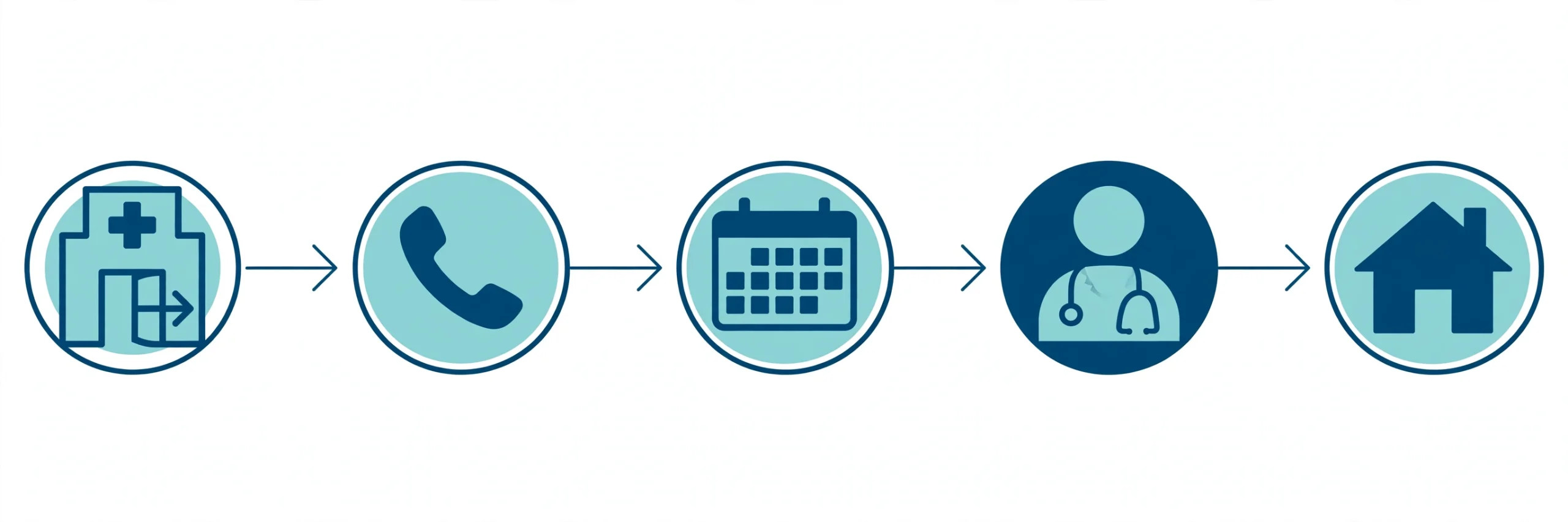
CCM and TCM serve the same patients at different moments — CCM for the steady months, TCM for the month after a discharge — and the question every practice asks is whether they can bill both. The short answer: not in the same period. Medicare does not pay CCM during the 30-day TCM service period, so the discharge month belongs to TCM. Once the 30-day period ends, CCM resumes the following month, and the care plan work done after the transition can count toward that month’s CCM minutes. Bill TCM for the transition month, then return the patient to the CCM program — and do not try to bill both for overlapping days, because the overlap is the denial.
The same one-program-per-month logic applies inside CCM: the three CCM families do not mix in a month, and CCM cannot be billed in the same month as principal care management or the newer advanced primary care management codes for the same patient. TCM also excludes certain same-period services: the face-to-face visit is bundled into the TCM code, so no separate E/M code for that visit, and the TCM period cannot overlap with another practitioner’s TCM claim for the same discharge. Commercial payers mostly follow Medicare’s framework for both programs, but not all of them pay TCM — check the payer’s policy before assuming a commercial TCM claim will pay like Medicare’s.
| Combination | Billable? | What to do instead |
|---|---|---|
| CCM (99490) + TCM (99495/99496), same period | No | Bill TCM for the transition month; resume CCM the following month |
| 99490 + 99491, same patient, same month | No | Pick one CCM family per month based on who did the work |
| 99490 + 99487, same patient, same month | No | Use complex CCM only when the 60-minute and MDM thresholds are met |
| TCM + separate E/M for the same visit | No | The visit is bundled into the TCM code |
| TCM + CCM the month after the 30-day period | Yes | Resume CCM once the TCM period has ended |
| CCM + AWV or E/M visit, same month | Yes | Bill the visit separately; time on the visit day does not count toward CCM minutes |
Most CCM and TCM denials are administrative, not clinical — the work happened, but the record does not prove it, or a deadline slipped. The CCM denials cluster around three failures: minutes below the threshold (19 minutes bills nothing), missing or undocumented consent, and a care plan that was never established or never shared with the patient. A fourth is the wrong code family — billing 99490 and 99491 together, or billing complex CCM without the 60 minutes and the decision making to support it. A fifth is a second practitioner billing CCM for the same patient in the same month; the payer’s system catches it even when neither practice knows about the other.
TCM denials cluster around the clock. The two-business-day contact is the most common single cause, followed by the visit outside the 7- or 14-day window and medication reconciliation that was never documented. A TCM claim also denies when the discharge was not from a qualifying setting, when another practitioner already billed TCM for the same period, or when the decision-making level in the note does not support the code billed. The prevention for all of these is the same: a checklist run before the claim leaves the practice, not after the denial arrives.
| Denial trigger | Program | Prevention |
|---|---|---|
| Fewer than 20 CCM minutes in the month | CCM | Running time log; do not submit until the threshold is met |
| Consent not documented | CCM | Consent note in the chart before the first billable month |
| No care plan, or plan never shared with the patient | CCM | Establish the plan at the initiating visit and document sharing it |
| Two CCM code families billed in one month | CCM | Pick one family per patient per month |
| First contact after 2 business days | TCM | Daily discharge-list check; one named owner |
| Visit outside the 7- or 14-day window | TCM | Book the visit at first contact, not after records arrive |
| Medication reconciliation not documented | TCM | Complete it on or before the visit date, in the note |
| Separate E/M billed for the TCM visit | TCM | Bill only the TCM code for that visit |
The practices that collect CCM and TCM revenue reliably do not treat either program as a month-end project. They run a short weekly routine: a discharge list checked every morning, a CCM time log updated the same day the work happens, and a Friday review of the patients whose TCM windows close the following week. The care coordinator owns the discharge list and the time log; the billing team runs a pre-submission checklist against each claim — consent on file, minutes at threshold, care plan current, TCM contact and visit dates inside their windows, medication reconciliation documented. Claims that fail the checklist are held and fixed, not sent and appealed.
Start small if neither program is running yet. Pick the 20 highest-risk patients on the panel — the ones with two or more chronic conditions and a recent hospital visit — and enroll them in CCM with consent and a care plan at their next visit. Put the discharge list in place the same week, with one person responsible for the two-day contact. In the first month, the goal is not maximum revenue; it is a clean process with no missed deadlines. The revenue follows the process: roughly $66 a month per CCM patient adds up across a panel, and a single TCM episode pays more than three months of CCM.
For practices that would rather have the tracking, the coding, and the claim follow-up handled externally, our team runs CCM and TCM billing as part of medical billing and medical coding and credentialing support for primary care practices — including the eligibility checks, the consent and care-plan documentation review, and the denial follow-up when a claim comes back. If you would like a review of what your panel could bill under these two programs, contact us and we will walk through it.
At least 20 minutes of clinical staff time in the calendar month, directed by the billing practitioner under general supervision. Each additional 20 minutes bills as 99439, up to two units. Fewer than 20 minutes bills nothing for that month.
No. Medicare does not pay CCM during the 30-day TCM service period. Bill TCM for the transition month, then resume CCM the following month once the TCM period has ended.
Missing the window disqualifies the TCM claim for that discharge — the payment of roughly $220 to $299 is lost. If two or more timely attempts were made and documented but the patient could not be reached, CMS allows the claim when the other requirements are met, so document every attempt.
Yes. CCM is a Part B service, so the deductible and 20% coinsurance apply. The patient must be told this when consent is obtained, along with the fact that only one practitioner can bill CCM for them in a month and that they can stop at any time.
Yes. Medicare allows the TCM face-to-face visit to be furnished via telehealth when appropriate, under the same timing and decision-making requirements. Confirm current flexibilities with your Medicare Administrative Contractor, since telehealth rules change.
Most commercial payers follow Medicare’s framework for CCM, and many cover TCM, but coverage and documentation rules vary by payer. Check the payer’s policy before billing, and do not assume a commercial TCM claim will pay at Medicare’s rate.


Leave a comment